
CAMPUS INNOVATION CASE STUDY / FINANCIAL ASSISTANCE
How Community College of Philadelphia connects public benefits, tax refunds, emergency grants, and financial guidance to student success.
PALLYWALLYU EDITORIAL · OCTOBER 2026 · RESEARCH CASE STUDY
| >$30.6M Reported financial resources connected | 19,000+ Students and family members served | 2013 Year program started |
College Foundation cumulative program figures; they include different types of assistance and are not an annual campus appropriation.
A tuition bill is only one part of the college affordability problem. A student may qualify for food assistance but never apply. Another may be owed a tax refund, need a small emergency grant to avoid eviction, or be eligible for campus employment but have no idea which office to contact. The problem is not always a shortage of available dollars. Sometimes it is the distance between a student and the money already meant to help.
Community College of Philadelphia built Single Stop around that insight. Rather than asking students to navigate public agencies, tax systems, emergency funds, and legal services alone, the college created an accessible entry point for screening, applications, referrals, and follow through. That makes it a particularly useful case study for colleges seeking to help students financially, not only supply food.
The model: one office, many financial pathways
There is no independently established ranking of the single most successful college basic needs program in the United States. Philadelphia stands out because the college reports substantial financial resources accessed, a federal evidence review found promising academic associations, and the broader Single Stop model has been studied at multiple institutions.
The model: one office, many financial pathways
Single Stop opened at the college in 2013. Today, students can meet with staff or start with an online screening tool to explore potential eligibility for public benefits and community services. The service helps students with SNAP food assistance, health coverage, childcare, cash and utility assistance, free tax preparation, legal aid, financial counseling, and campus emergency funds. Staff can help with applications and direct students to agencies that make eligibility decisions.
The distinction is important. A benefits screening is not a benefits approval, a referral is not money received, and emergency assistance is not guaranteed. The operating model succeeds only when the college can follow a student from initial need through a completed application, a real service connection, or a confirmed benefit.
A broader campus financial support system
The college offers complementary programs that should not be confused with Single Stop itself. Its KEYS program supports students already receiving SNAP or Temporary Assistance for Needy Families by connecting public support with academic advising. Financial Aid offers Federal Work Study, which provides eligible students with paid part time work subject to funding and available jobs. The college foundation also finances scholarships and emergency grants. Together, these services create more than one route to financial stability; the evidence does not show that every student uses them as a single coordinated package.
What the financial data actually show
The college foundation reports that, since opening, Single Stop has served more than 19,000 students and family members and connected them with more than $30.6 million in financial resources. These are cumulative institutional figures. The count includes family members, and the resources can include tax refunds, cash assistance, and noncash benefits. They should not be read as $30.6 million in cash grants deposited directly into student bank accounts.
The original model produced results quickly. A 2014 college report said that more than 750 students had received free tax preparation help and that refunds had already exceeded $1 million. This is a tangible illustration of how benefits navigation can bring additional dollars into students’ households without requiring a college to create the underlying public programs.
The foundation also reports separate campus aid investments for fiscal year 2025: 1,042 scholarships totaling about $1.64 million and 2,006 emergency fund awards backed by $491,654 in emergency aid funding. Transportation, food, and rent together accounted for three quarters of those emergency award uses. These are foundation figures, not an additional amount to be automatically added to the cumulative Single Stop total.
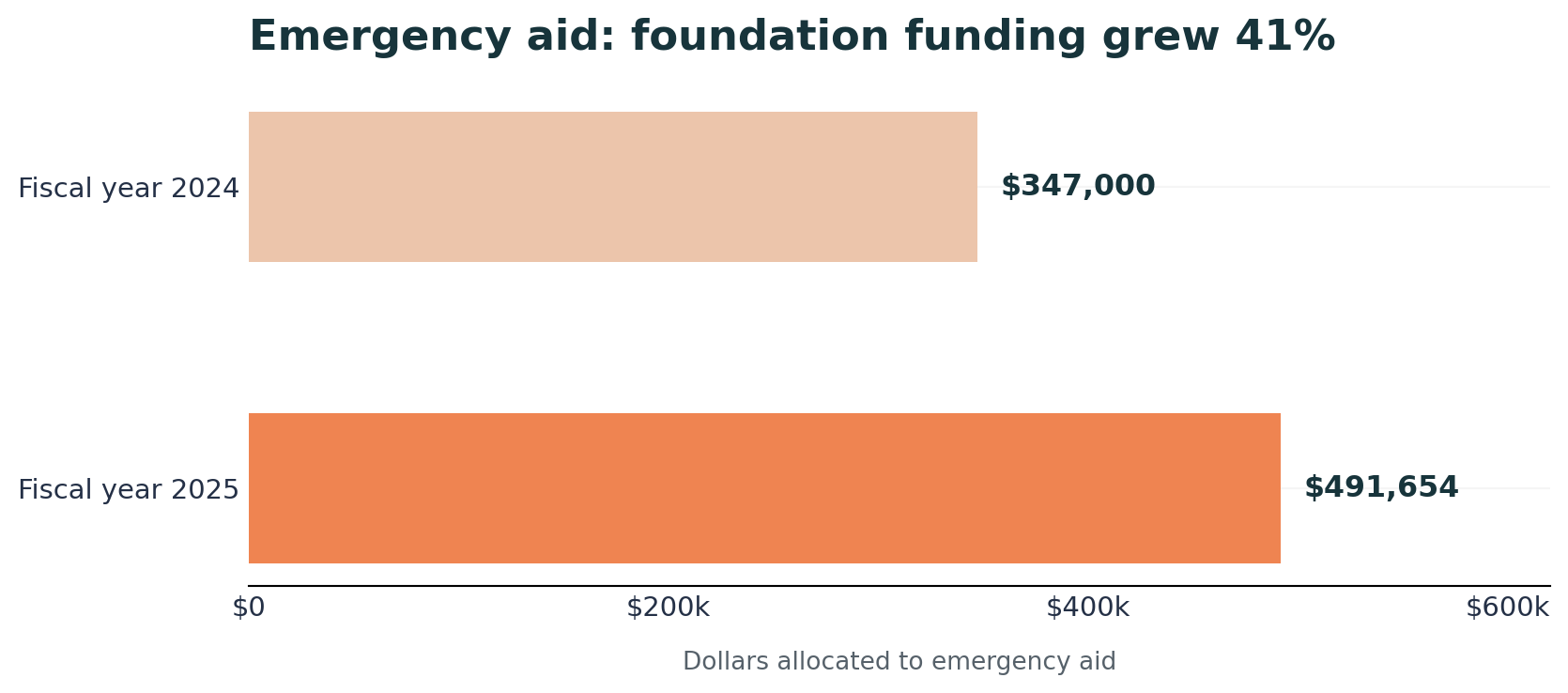
Reported foundation emergency aid funding, two fiscal years. The increase describes available funding and awards, not a measured improvement in persistence.
What independent research found about student outcomes
The U.S. Department of Education’s What Works Clearinghouse reviewed Single Stop evaluations and classified its evidence for academic achievement and progress in college as potentially positive. One of the studies was conducted at Community College of Philadelphia. It compared students who used Single Stop with a matched group and met federal evidence standards with reservations. Because students were not randomly assigned, the results remain stronger evidence of association than of an assured effect at every campus.
After six semesters, 25.4% of participating students in the reviewed study met the reported three year persistence measure, compared with 15.8% of comparison students. The 9.6 percentage point gap matters, but it is not a graduation rate and does not mean a grant caused the entire difference.
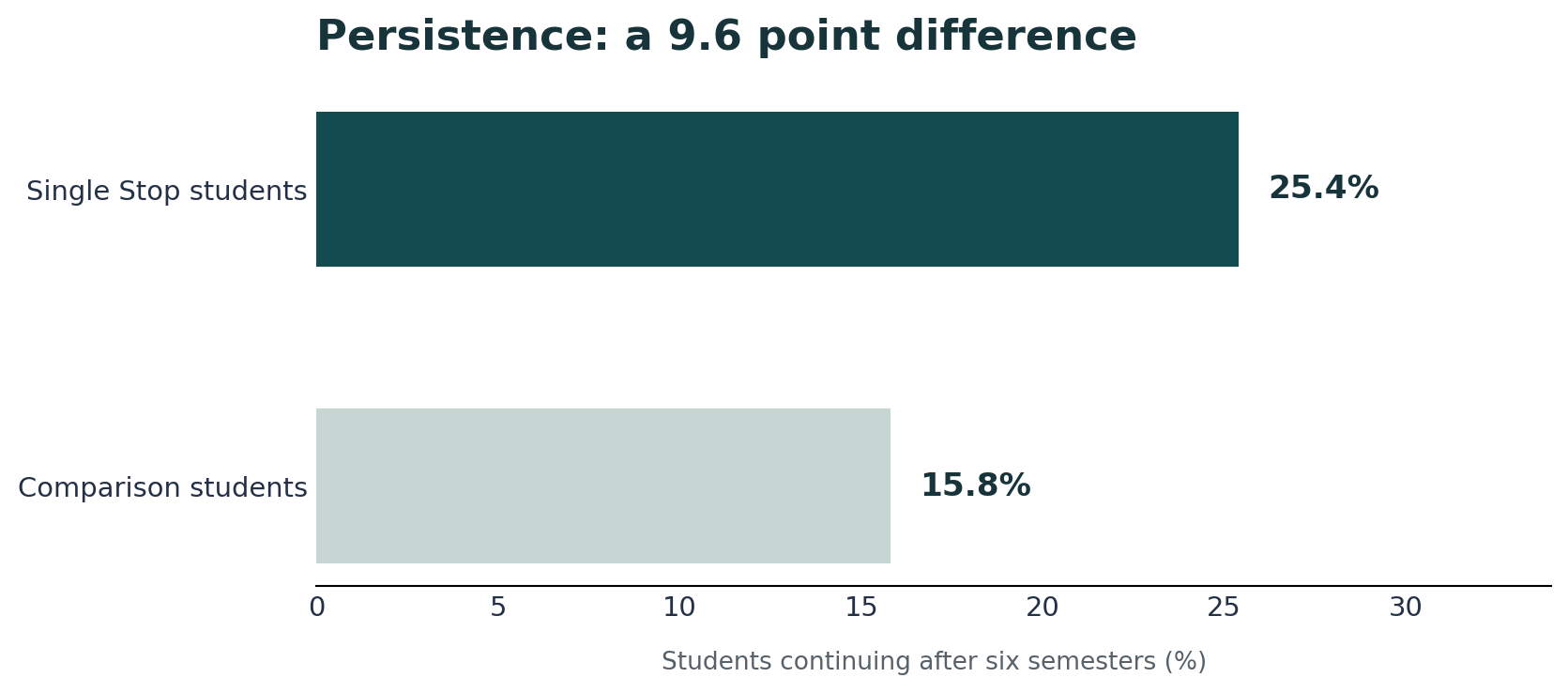
Independent federal review of a matched comparison study at Community College of Philadelphia; six semester persistence measure, 610 students.
Participating students also completed 52.8% of attempted credits, versus 46.5% in the comparison group, and their cumulative grade point average was 2.59 versus 2.41 after six semesters. Those are academic measures, not estimates of the financial value of benefits obtained.
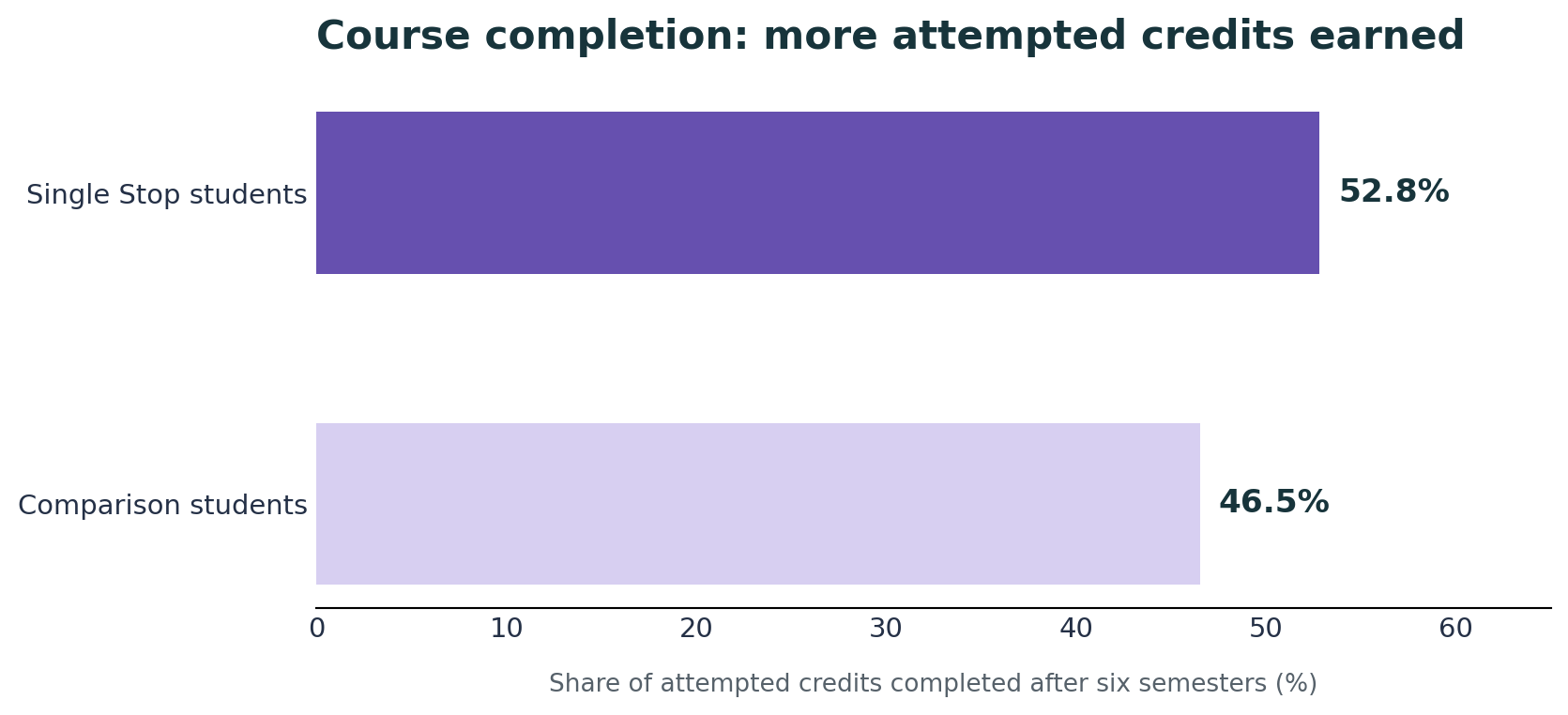
Independent federal review of the same college evaluation. Credit completion analysis included 592 students; the GPA analysis included 526 students.
The critical caution: a program cannot help students who never use it
Single Stop’s results have not been uniformly positive everywhere. A newer RAND study at ten colleges in Colorado and North Carolina tested an expansion of the model. Only 12.7% of students offered the intervention completed a benefits screener, and just 0.9% engaged with case managers. With so little meaningful participation, the researchers did not observe changes in academic outcomes and concluded that the study could not establish the effectiveness of a fully implemented program.
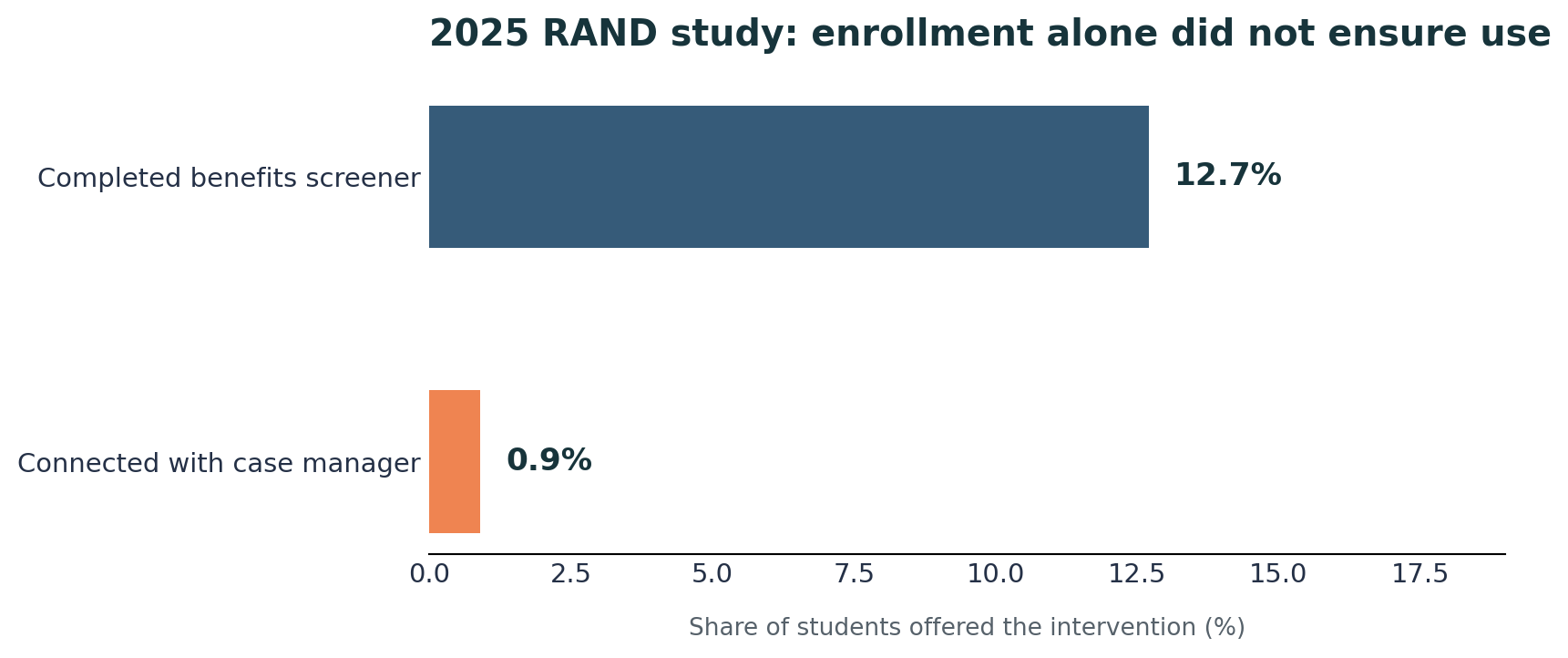
These figures describe the ten college RAND implementation study, not service use at Community College of Philadelphia.
This is a powerful replication lesson: buying screening software or opening an office is not enough. Students must know it exists, trust it, have time to use it, and receive hands on assistance through difficult application steps. RAND emphasized staff capacity, leadership support, practical outreach, and clear follow through.
Why Philadelphia offers a replicable model
Make the entry point obvious
Offer an easy first conversation through orientation, advising, financial aid, and student success classes. Provide a self service option, but also make a real counselor easy to reach. Position the service as a financial success resource for students rather than a last resort for people in crisis.
Turn eligibility into enrollment
Map the benefits that matter in the institution’s state: SNAP, Medicaid, childcare support, income tax credits, utility support, and local aid. Screen students with consent, explain likely requirements, help assemble documents, and follow applications until a decision is made. The state agency, not the college, makes benefits decisions. SNAP student and work requirements can change, so legal and eligibility guidance should be reviewed regularly.
Connect cash, work, and academic support
Coordinate referrals to emergency grants, institutional scholarships, Pell and state aid reviews, Federal Work Study, and counseling for financial problems. At Philadelphia, those resources involve multiple campus offices and programs. For replication, a shared referral process and accountable staff members are more important than placing every service under one budget line.
Give students options beyond a single campus
Create agreements with tax preparation partners, benefits agencies, legal aid organizations, food providers, and community nonprofits. Colleges with multiple locations can offer regional access and remote appointments. Staff should know which services are limited, how long decisions take, and where to redirect students when one application fails.
A practical 120 day implementation plan
Days 1 to 30 | Build the resource and funding map. Appoint a program lead from student affairs or financial aid. Inventory local SNAP support, Medicaid enrollment assistance, tax preparation, emergency aid, existing work study opportunities, state grants, and campus funds. Meet public agency partners and define privacy, referral, and eligibility rules.
Days 31 to 60 | Build the front door. Design a simple screening and intake process. Train two or more staff to handle warm handoffs and applications, not only referrals. Develop a student communications plan through orientation, advising, email, and trusted faculty.
Days 61 to 90 | Pilot with a high need group. Run a pilot with a manageable cohort, such as students receiving Pell Grants, student parents, returning adults, or students who request emergency help. Offer benefits application assistance and a route to tax and financial aid experts. Track application status, days to service, and confirmed assistance.
Days 91 to 120 | Improve and report. Review the share of screened students who complete applications, approvals obtained, dollars and noncash support confirmed, and unmet requests. Collect anonymous student feedback. Compare persistence and credit outcomes carefully, preferably with an appropriate matched group or designed evaluation.
What every college should measure
A useful financial assistance dashboard should report different outcomes separately: students reached; unique students screened; applications submitted; applications approved; money and noncash benefits actually received; emergency grants disbursed; work study positions obtained; and repeat requests for help. Track dollars by source and by year so that tax refunds, public benefits, philanthropic gifts, and institutional aid are not confused or double counted.
Academic success measures should include credit completion, course success, persistence, and graduation, but colleges should not treat a descriptive trend as proof that one service caused the change. Keep program participation voluntary, limit access to sensitive data, and report small demographic groups carefully to protect student privacy.
The larger lesson for American higher education
Community College of Philadelphia shows that a basic needs center can act as financial infrastructure. Its impact is not simply that students found assistance; it created a practical path between public resources and people eligible to receive them. The strongest feature of the model is the combination of benefits access, human guidance, emergency support, and academic partnerships.
The challenge for schools borrowing the model is to reproduce the real service, not the appearance of one: outreach that reaches students, staff who can complete applications, and records that show confirmed financial help. Start with existing public programs, build credible local partnerships, and evaluate outcomes honestly. That approach is more useful than claiming a campus is successful just because a program exists.
Sources and research notes
Research source list. The publications below support this article. Figures labeled as college or foundation reports are institutional claims; federal reviews and RAND evaluations are independent research. Sources are intentionally unnumbered and full web addresses are included for transparency.
Community College of Philadelphia. Single Stop program and services.
Official program descriptions, benefits assistance, free tax preparation, emergency grants, and self screening.
https://www.ccp.edu/student-services/student-assistance-centers/single-stop
Community College of Philadelphia Foundation. Programs and student resources.
Cumulative Single Stop resources and people served; KEYS support for recipients of SNAP and TANF.
https://foundation.ccp.edu/programs
U.S. Department of Education, What Works Clearinghouse. Single Stop evidence snapshot (2020).
Independent synthesis rating academic achievement and college progress potentially positive.
https://ies.ed.gov/ncee/WWC/EvidenceSnapshot/709
U.S. Department of Education, What Works Clearinghouse. Single Stop final impact and implementation report study review.
Philadelphia matched comparison data for persistence, credits completed, and GPA; study limitations.
https://ies.ed.gov/ncee/wwc/Study/89389
Zhu, Harnett, and Scuello. Single Stop Final Impact and Implementation Report (2018).
Original Philadelphia study reviewed by the What Works Clearinghouse.
RAND. Connecting Students to Basic Needs Support: An Evaluation of Single Stop Across Ten Colleges (2025).
Experimental implementation evaluation, use rates, limitations, and replication lessons.
https://www.rand.org/content/dam/rand/pubs/research_reports/RRA3700/RRA3771-1/RAND_RRA3771-1.pdf
Community College of Philadelphia Foundation. A Year of Generosity, annual report for fiscal year 2025.
Emergency funding, scholarship totals, number of awards, and student experience.
Community College of Philadelphia Foundation. 2024 to 2025 In Review.
Foundation emergency aid and scholarship totals with an additional summary of recent support.
https://foundation.ccp.edu/2025review/
Community College of Philadelphia. Strong Demand for Single Stop as Students Find New Dollars (2014).
Early tax refund results, free preparation, health insurance navigation, and public benefits access.
Single Stop. Community College of Philadelphia case study.
Program operator perspective on outreach, campus integration, and student needs; contextual rather than independent evaluation.
https://singlestop.org/case-studies/community-college-of-philadelphia-case-study
Community College of Philadelphia. Federal Work Study.
Separate college employment program for eligible students with demonstrated financial need.
Pennsylvania Department of Human Services. SNAP College Employability Programs.
Institutional outreach and program exemption guidance for potentially eligible college students.
https://www.pa.gov/agencies/dhs/resources/snap/snap-college-employability-programs
Pennsylvania Department of Human Services. Supplemental Nutrition Assistance Program.
Official SNAP eligibility, application, and access information.
https://www.pa.gov/agencies/dhs/resources/snap
Community College of Philadelphia Foundation. The Impact of Generosity.
Emergency assistance, scholarship results, and foundation funding context.
https://foundation.ccp.edu/impact/
Community College of Philadelphia. Student Assistance Centers.
College network of academic and nonacademic services that includes Single Stop.
https://www.ccp.edu/student-services/student-assistance-centers
Editorial note: Program figures from public websites may reflect different publication dates and reporting definitions. This article does not independently audit benefit claims or establish that a single program is the most effective in the nation.