
PALLYWALLYU CASE STUDY • OCTOBER 2026
How UC Irvine and Orange County turned a complicated public benefits application into a campus service that other colleges can adapt.
A student can be eligible for food assistance and still never receive it. The reason is often not a lack of need. It is the friction between a student who has classes, work and limited time, and a benefits system that requires forms, document verification and an interview.
UC Irvine has a practical response. Its Basic Needs Center brings students and county eligibility workers together for CalFresh enrollment events. In some cases, students can finish an application, complete an interview and leave with an Electronic Benefit Transfer card the same day. The defining innovation is not a new food subsidy. It is a much simpler route into an existing public program.
The measurable results, and what they mean
By November 2025, UC Irvine and the County of Orange Social Services Agency had held 41 CalFresh enrollment parties. The university reported that 96% of its student applicants in calendar 2025 were approved. It compared that result with a roughly 45% statewide approval rate among college student applicants. Event capacity had doubled from 60 to as many as 120 appointments.
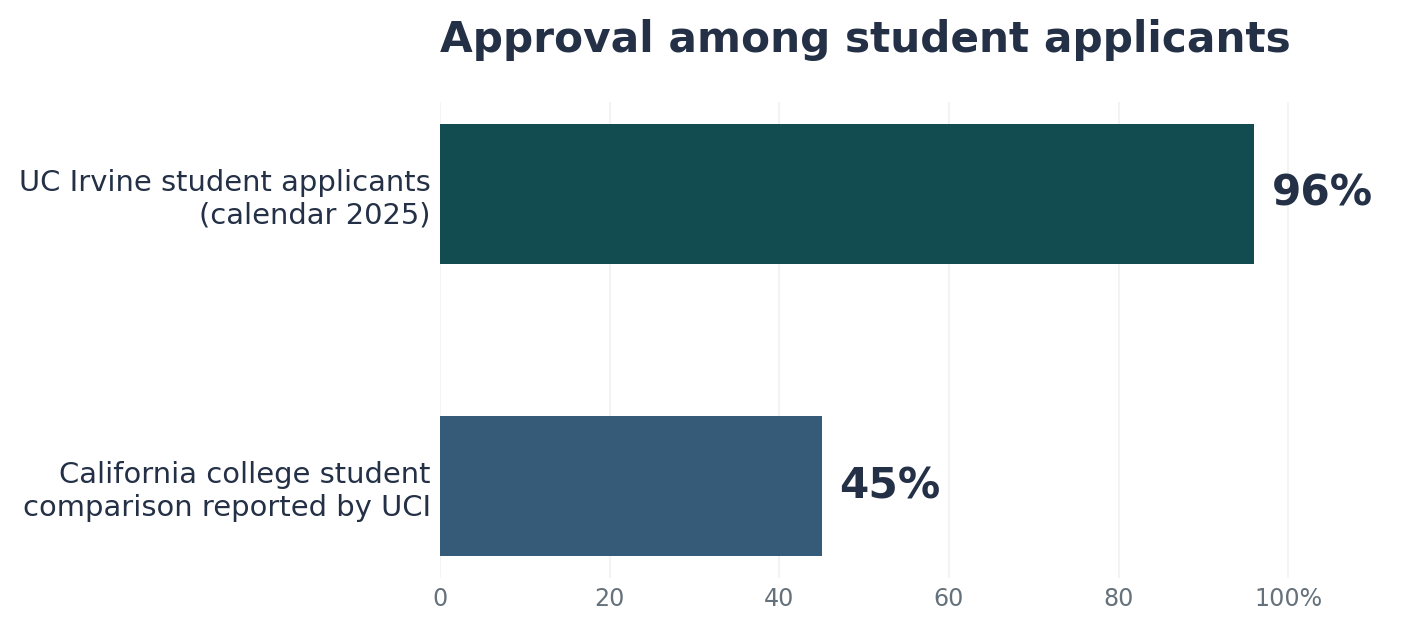
FIGURE 1 | UC Irvine published these approval percentages in November 2025. The campus group and statewide comparison may differ in eligibility, prescreening and case mix. This is not a controlled estimate of program impact.
The 51 percentage point difference is striking. It is also important to interpret it properly: the university did not publish the applicant denominator, independent verification of the rates, or a randomized comparison. Prescreening may mean that applicants arriving at its events are more likely to qualify. The result is encouraging implementation evidence, not proof that the same approval rate would follow at every college.
The need is substantial. UC Irvine reported that 43% of its students experienced food insecurity according to its undergraduate experience survey. That survey indicator describes student hardship, not the CalFresh application cohort.
How UC Irvine built the partnership
A direct working relationship with the county
In November 2020, UC Irvine shifted to a direct relationship with Orange County Social Services Agency for CalFresh assistance. University of California legislative reporting described this as a way to provide campus staff with a direct county contact for eligibility questions. The local partnership subsequently supported campus enrollment events and regular county assistance hours.
Preparation happens before the county worker arrives
The Basic Needs Center offers eligibility guidance, appointments with trained student advocates, help gathering application documents and online preparation. Students are encouraged to prepare before the expedited event. This reduces the chance that an interview is missed or a file is stalled over missing information.
The student can reach an eligibility worker on campus
At enrollment parties, county personnel help new applicants submit applications and complete interviews on the same day. UC Irvine reports that a county mobile unit has even brought card printing equipment so students approved on site can leave with a card and benefits available. Campus news described an approximately 90 minute experience for some students, rather than a process that can otherwise take up to 30 days. This is an example of what the events can achieve, not a guaranteed timeline for every application.
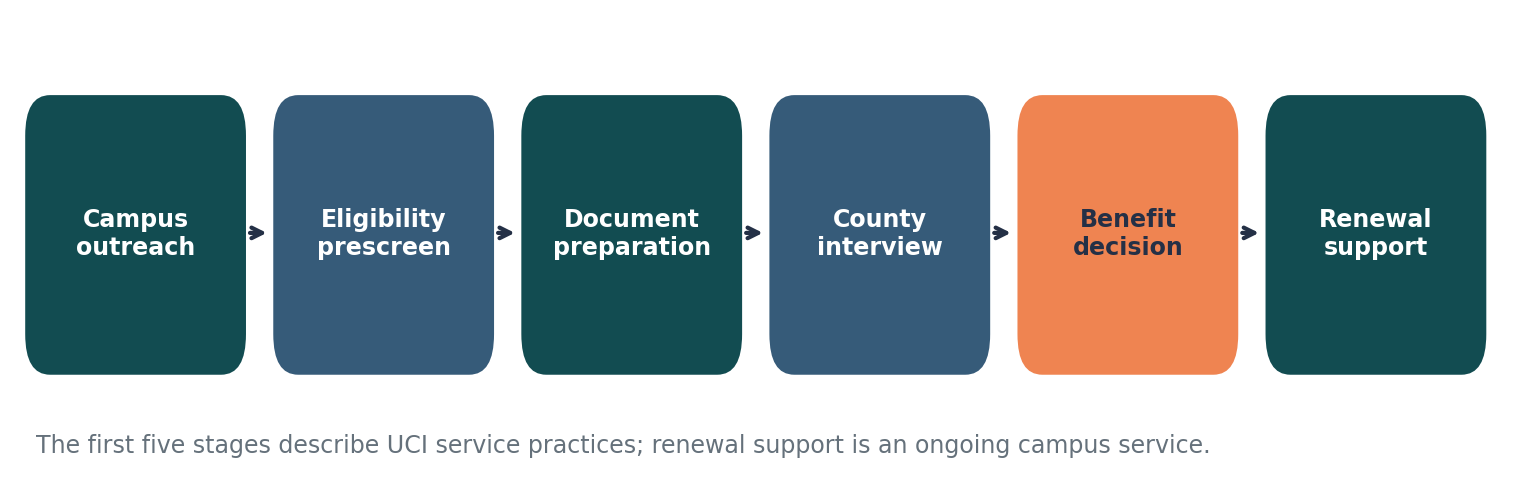
FIGURE 2 | A simplified student journey derived from UC Irvine service descriptions. Eligibility decisions are made by the county agency, not by the university.
Support does not end after approval
The center also helps students manage pending applications, complete required periodic reports and seek renewal. Its published CalFresh process guidance explains how students can receive assistance with the six month SAR 7 report and annual recertification. Retaining benefits can matter as much as opening the first case.
Scaling a service without constructing a new building
UC Irvine expanded its enrollment event capacity from 60 students to as many as 120. Its experience illustrates how coordinated staffing, scheduled appointments, prepared applications and dedicated county presence can increase the throughput of an existing program.
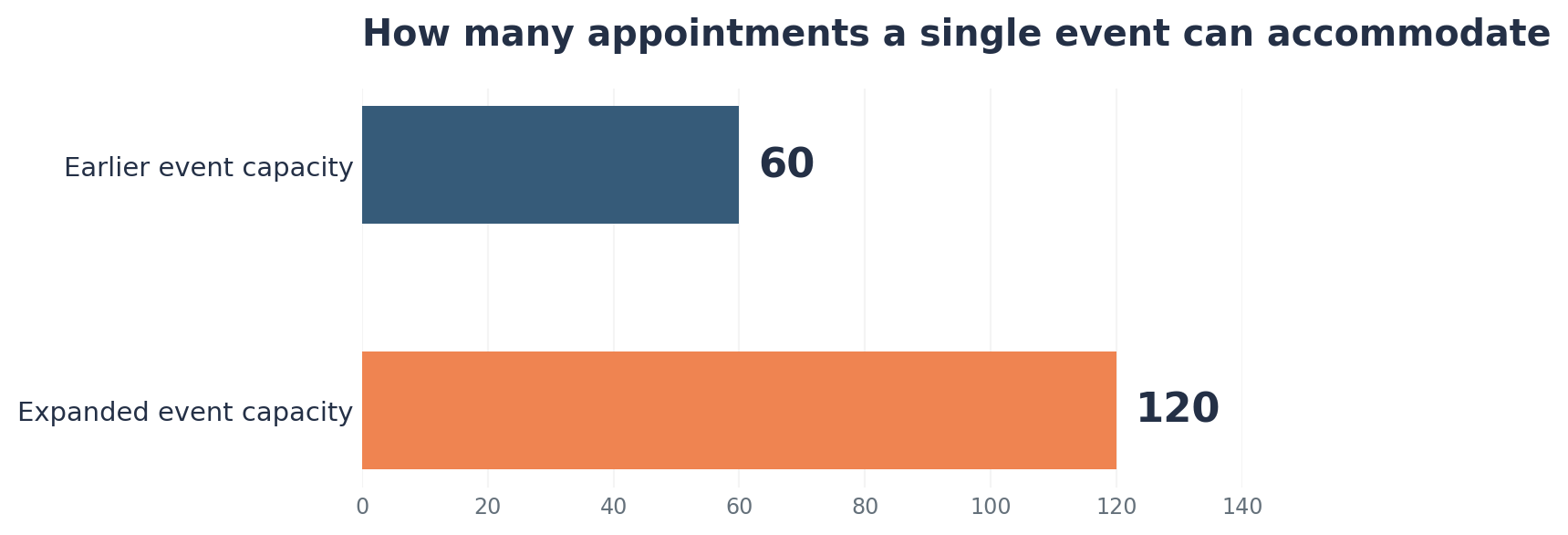
FIGURE 3 | Reported appointment capacity per UC Irvine enrollment event. These are capacity figures, not verified attendance or approvals. Source: UC Irvine campus news, November 2025.
The work also attracted attention outside Orange County. UC Irvine reported a pilot initiative involving ten California counties that encouraged other colleges and universities to adapt the campus model. That is evidence of interest in replication, not a published evaluation showing that ten counties achieved the same results.
Why this model matters beyond California
The underlying problem is national. Colleges often have students who qualify for public programs yet never complete an application. California Policy Lab research found that only about one in three or one in four eligible students in the historical populations studied received CalFresh. Its newer administrative analysis found that 21.4% of UC undergraduates participated in CalFresh at some point during academic year 2023 to 2024. That latter figure is participation among all UC undergraduates, not approval among applicants and not a UC Irvine specific rate.
Outside California, schools can follow the same approach with their state SNAP agency or local benefits office. Federal SNAP eligibility rules, student exemptions, interview arrangements, data sharing permissions and processing timelines vary. A college should adapt the operating model, not copy the California eligibility checklist or promise the same financial benefit.
A 2026 policy change makes accurate advising even more important
California announced in October 2026 that students enrolled in undergraduate degree programs at its public colleges now meet an important CalFresh student eligibility pathway. UC Irvine explains that this designation addresses the student status requirement for its undergraduates, but does not remove income, household composition, immigration status and other program rules. Graduate programs have different requirements. New federal and state work rules also require up to date screening.
California currently advertises benefits of up to $306 a month for qualifying individuals. That is a maximum, not a typical student award and not money delivered by UC Irvine itself. Benefits are determined by the administering agency according to applicable rules.
What an adopting college needs to put in place
Leadership and agreement
Appoint a campus program owner and identify a named agency liaison. Agree on which office manages outreach, document preparation, appointments, case questions, renewals and escalations. The University of California Campus County Partnership Toolkit recommends regular meetings and clearly assigned responsibilities. A formal data sharing agreement may be useful but must be developed with privacy and legal review.
Staff capacity and a student friendly workflow
Start with a small appointment day staffed by an existing basic needs or financial aid team and a benefits eligibility partner. Develop a simple eligibility information page, a document checklist, a private interview space, a way to book appointments and a warm referral process for students who cannot qualify for SNAP. Staff should be trained to explain eligibility without promising approvals.
Funding, technology and privacy
Budget for campus coordination, student advocate training, space, accessible outreach, interpretation and student follow up. The government benefit itself is not paid by the university. Never collect or circulate sensitive application documents in ordinary spreadsheets or unapproved systems. Obtain necessary consent before sharing individual information and ensure the agency remains responsible for eligibility determinations.
A realistic 120 day implementation plan
Days 1 to 30 | Build the partnership
Invite the SNAP agency, financial aid, basic needs, legal counsel and student representatives. Name a coordinator, map current student barriers, set privacy rules and agree on a pilot goal.
Days 31 to 60 | Build the student journey
Write outreach materials, train navigators, establish a document checklist, set appointment slots and create paths for students with urgent food needs or pending cases.
Days 61 to 90 | Run the first enrollment event
Host an appointment based event with agency eligibility staff. Track attendance, completed interviews, application submissions, missing documents and student experience with appropriate consent.
Days 91 to 120 | Improve and repeat
Review application and approval outcomes with the agency, identify avoidable delays and schedule recurring events. Add a renewal support process and report a clear campus scorecard.
The scorecard every campus should publish
An implementation that merely counts event attendance misses the core objective: eligible students actually receiving and retaining assistance. At minimum, report the number of students reached, students screened, applications filed, interviews completed, applications approved or denied, median days to decision, benefits received when legally available, and renewals completed. Use clearly stated time periods and denominators.
For a stronger evaluation, compare outcomes over time and with matched or randomly assigned outreach groups where ethical and feasible. Measure food security and student feedback separately from retention and completion. Do not claim that a rise in SNAP approvals proves an improvement in graduation unless those outcomes have actually been studied.
The lesson for every college
UC Irvine demonstrates how a university can turn an existing federal food assistance program into a more accessible campus resource. The partnership puts application help, trained advocates, county decision makers and in some cases immediate EBT card access within a process that students can use between academic obligations.
Its approval rate is impressive, and the county partnership is concrete enough to replicate. The next stage of evidence should answer how many students receive and retain benefits, how much assistance reaches them and whether food insecurity declines. That is the standard other colleges should aim for as they adapt this model.
Sources and research notes
The sources below are unnumbered, with the complete published URLs. UC Irvine program statistics are identified as university reported figures; independent and statewide findings are labeled separately. No direct campus student record or confidential program data were used.
UC Irvine News, UC Irvine Basic Needs Center cohosts record breaking CalFresh enrollment parties (November 12, 2025). https://news.uci.edu/2025/11/12/uc-irvine-basic-needs-center-co-hosts-record-breaking-calfresh-enrollment-parties/
UC Irvine News, A feast of opportunity (November 13, 2025). https://news.uci.edu/2025/11/13/a-feast-of-opportunity/
UC Irvine Basic Needs Center, Virtual and in person CalFresh appointments. https://basicneeds.uci.edu/virtual-in-person-calfresh-appointments/
UC Irvine Basic Needs Center, CalFresh application assistance. https://basicneeds.uci.edu/calfresh-application-assistance/
UC Irvine Basic Needs Center, CalFresh eligibility. https://basicneeds.uci.edu/calfresh-eligibility/
UC Irvine Basic Needs Center, CalFresh application process. https://basicneeds.uci.edu/calfresh-application-process/
UC Irvine Basic Needs Center, Pantry anniversary and timeline. https://basicneeds.uci.edu/pantry-anniversary/
University of California Office of the President, 2020 to 2021 Basic Needs Legislative Report. https://www.ucop.edu/operating-budget/_files/legreports/20-21/uc_basic_needs_legrpt20-21.pdf
University of California, Campus County Partnership Toolkit (October 2024). https://basicneeds.ucop.edu/resources/campus-county-partnership-toolkit-october-2024.pdf
University of California research brief, Helping College Students Get SNAP. https://basicneeds.ucop.edu/resources/helping-college-students-get-snap.pdf
California Policy Lab, Filling the Gap (August 2024). https://capolicylab.org/filling-the-gap-calfresh-participation-among-university-of-california-and-california-community-college-students/
California Policy Lab, CalFresh Participation Among California College Students, 2023 to 2024 Update (August 2026). https://capolicylab.org/calfresh-participation-among-californias-college-students-a-2023-24-school-year-update/
Office of the Governor of California, California improves access to CalFresh food benefits (October 9, 2026). https://www.gov.ca.gov/2026/10/09/california-improves-access-to-calfresh-food-benefits-helping-college-students-get-up-to-306-a-month-to-buy-groceries/
California Department of Social Services, CalFresh work and community engagement requirements. https://www.cdss.ca.gov/inforesources/calfresh/abawd/abawd
USDA Food and Nutrition Administration, Student Eligibility for SNAP. https://www.fna.usda.gov/snap/eligibility/student
Editorial note: The proposed campus replication plan and monitoring scorecard are PallyWallyU recommendations built from the cited models. They are not quoted UC Irvine procedures or tested causal findings.