
CASE STUDY • FOOD ACCESS • OCTOBER 2026
The Meal Swipes That Kept Students Fed During Campus Breaks
How the University of Chicago turned unused dining benefits into an award winning food access model other colleges can adapt.
When Christopher Toote arrived in the United States as a student from the Bahamas, a Thanksgiving dining hall closure left him scrambling for food. Years later, as Executive Director of UChicago Dining, he helped turn that experience into a campus solution. Community Action Reaching Every Student, or C.A.R.E.S., provides meals during shorter academic breaks and groceries during the longer winter closure.
The innovation is surprisingly practical. Instead of assuming unused meal swipes must disappear at the end of a term, UChicago built a donation channel and paired it with dining services, student outreach, volunteers, and grocery distribution. The result is a model that does not require a college to build a new food pantry before it can begin helping students.
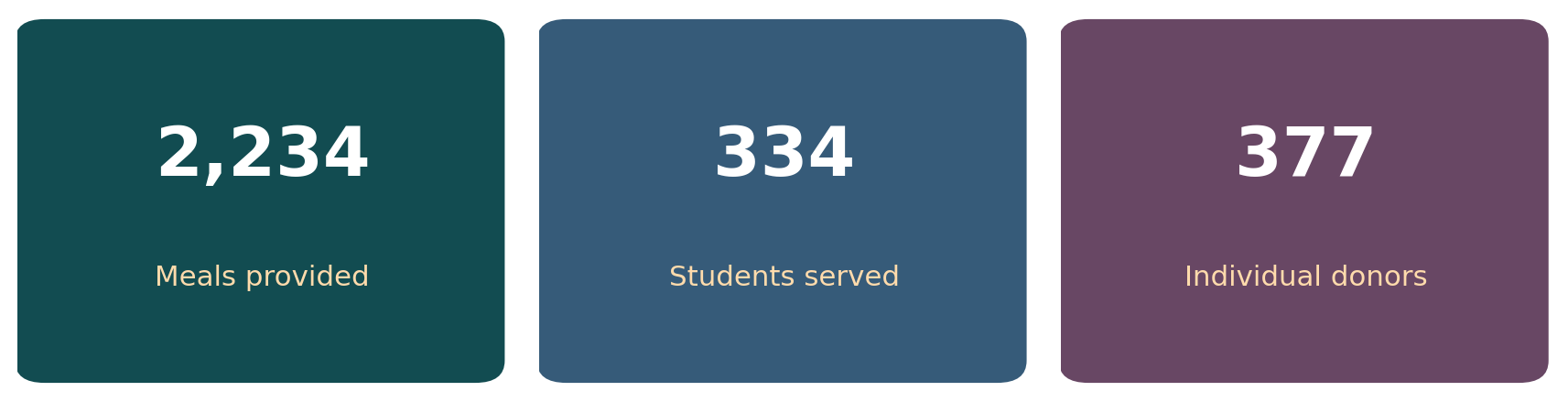
UChicago Campus and Student Life reported these separate service measures for the 2024 to 2025 academic year. Meal counts do not represent unique students, and donor counts are not recipients.
The student need that appears when campuses close
Food insecurity can become acute when dining halls reduce hours or close during Thanksgiving, winter, and spring recesses. Students who cannot travel home, including some international students, may remain on campus without affordable kitchens or convenient groceries. A standard meal plan may not cover food during closure periods.
UChicago designed C.A.R.E.S. for undergraduate and graduate students, including students without a traditional meal plan. During Thanksgiving and spring breaks, participating students can receive prepared dining hall meals. For winter closure periods, the program has arranged grocery packages designed to cover multiple meals and accommodate dietary preferences. The original pilot included packages with supplies for 21 meals.
The key idea: convert unused meal benefits into access
UChicago estimated that about 22,000 guest meal swipes existed each quarter and that roughly 15,000 of them previously went unused. This was the opportunity. With the dining partner’s agreement, students gained a way to contribute eligible guest swipes rather than leave them unused. The 2025 university account states that students can donate up to four swipes per quarter.
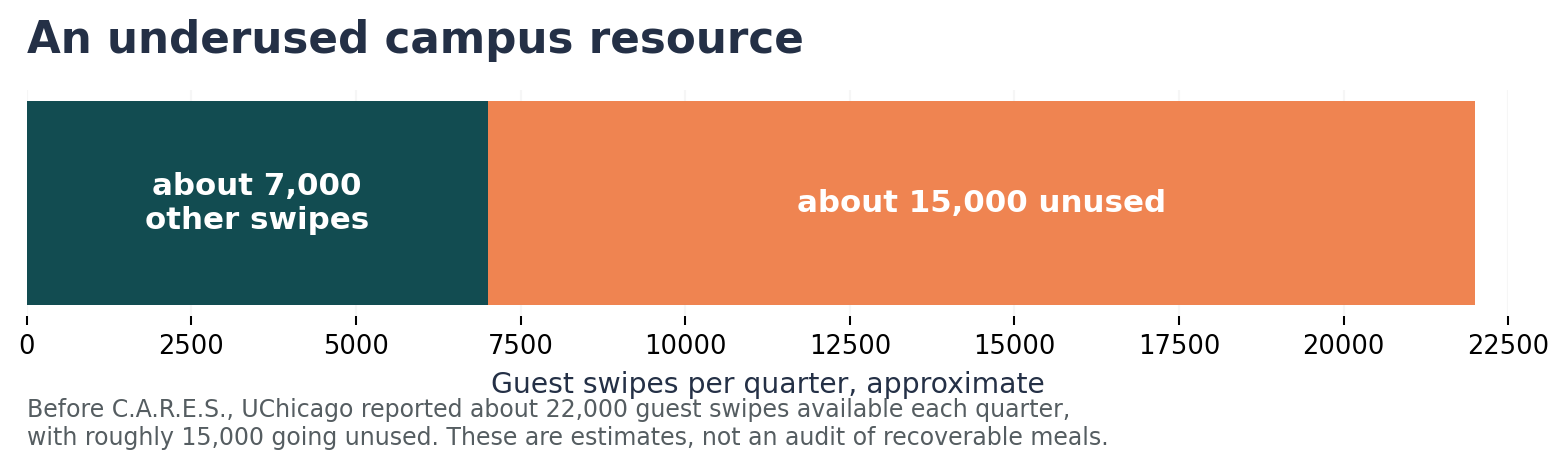
Estimated quarterly guest swipe availability before C.A.R.E.S., based on a December 2025 UChicago account. The remaining approximately 7,000 is calculated as available minus unused; it does not indicate the program can recover all unused swipes.
The campus used the GET app, already familiar to students for viewing balances, to make donation easier. That design choice matters: the more steps a donor must complete, the less likely an otherwise available resource is to reach a student. The university attributes part of the later increase in donations to this simpler process and stronger student government outreach.
How the program operates
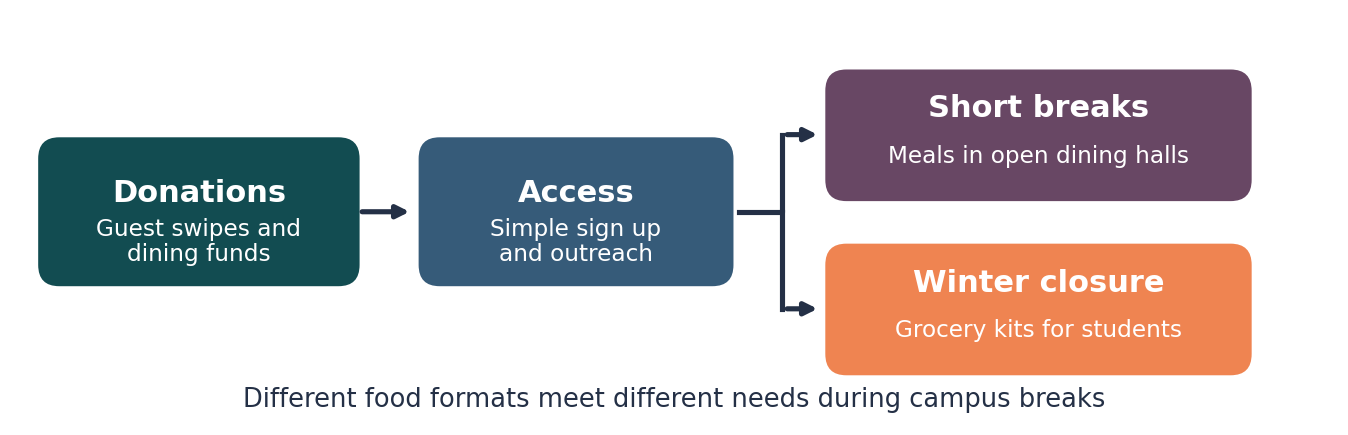
Simplified replication diagram based on UChicago’s published description. Exact eligibility, donation rules, service sites, and privacy procedures should be set locally by each campus.
The program is a partnership among UChicago Dining, Chartwells Higher Education Dining Services, the Center for Identity and Inclusion, student organizations, and volunteers. Staff handle food service operations and student communications, while students and supporters help supply swipes, dining dollars, goods, and volunteer time.
The original 2022 to 2023 pilot enrolled 348 students and reported 9,644 meals. About 440 donors contributed 1,144 swipes, and 30 volunteers provided approximately 500 hours of support. University reporting also described donated groceries and three years of approved philanthropic support. These ingredients helped move the program beyond a one time event.
Results: reach, participation, and changing behavior
In the 2024 to 2025 academic year, the university reported 2,234 C.A.R.E.S. meals provided to 334 students and 377 individual donors. In a separate December 2025 feature, the university reported 1,918 donated guest swipes and described this as a 413% increase over the prior academic year. The annual roundup uses the less specific description “over 1,700 meal swipes.” These are two university publications and should not be added together as separate donations.
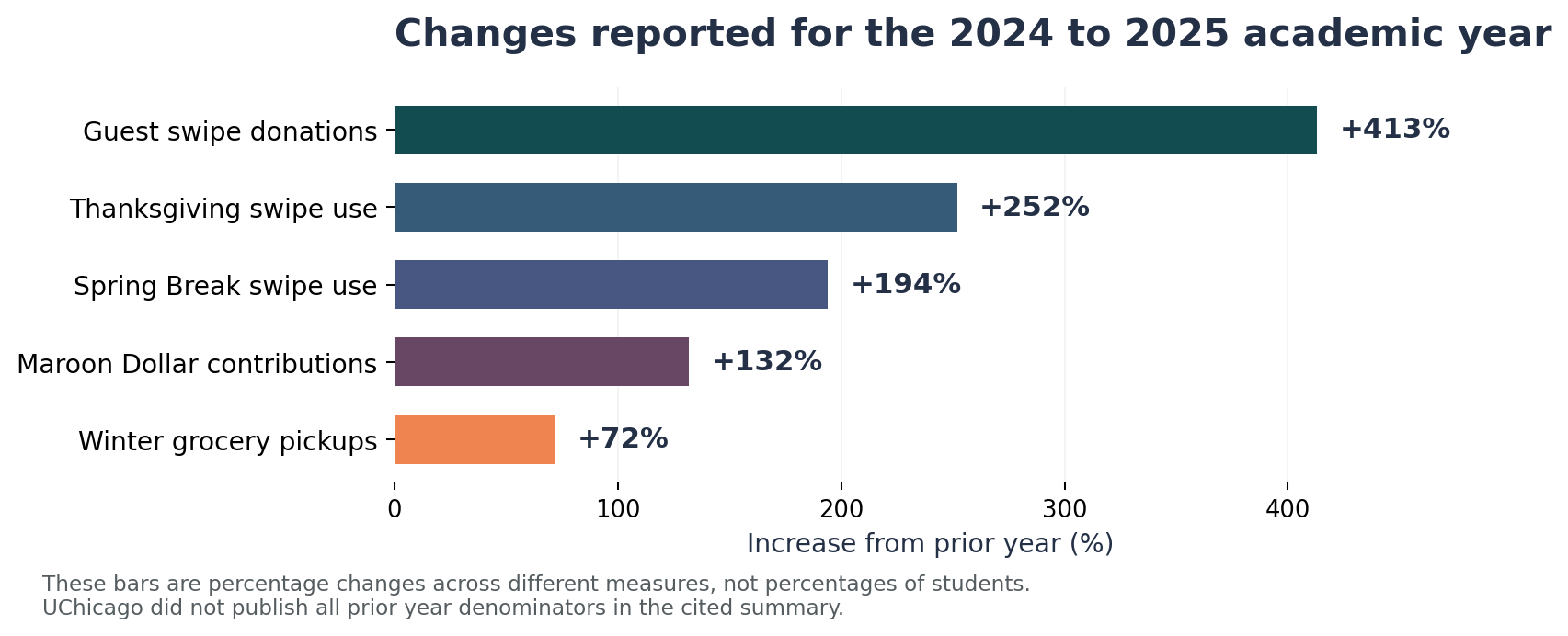
Percent changes reported in the university’s September 2025 annual summary. These categories have different denominators and reflect year over year growth, not shares of the student population.
The university also reported a 132% rise in donated Maroon Dollars, increased swipe use during Thanksgiving and spring break, and more winter grocery pickups. These patterns are consistent with better awareness, donation convenience, and participation, although no causal evaluation isolates the effect of any one change.
An important measurement caution: the 2022 to 2023 pilot reported 9,644 meals while the 2024 to 2025 annual summary reported 2,234. The public articles do not give enough methodological detail to treat these figures as directly comparable measures over time. Accordingly, this case study does not chart them as a decline or an increase.
An award winning approach that other universities noticed
UChicago announced in 2023 that C.A.R.E.S. had received the 2022 Sustainability Award for Outreach and Education from the National Association of College and University Food Services. The award recognized the outreach effort and the program’s contribution to social responsibility in campus dining.
The university also reported that the University of Illinois Chicago and DePaul University launched versions of the approach and that UChicago Dining was sharing its model with additional institutions. UIC currently publishes an emergency meal assistance program, U&I Care Meals, illustrating a related method of allocating dining access. That is not independent proof that the UIC program is identical to UChicago C.A.R.E.S.
Why leadership and campus culture mattered
Christopher Toote’s leadership connected an overlooked student experience to a concrete operating problem. Kristina Baker, identified by the university as Associate Director of CSL Technology Solutions and a program organizer, helped explain the move toward app based donations. The dining contractor and student government turned that insight into processes, communications, and volunteer capacity.
This is the larger lesson: a strong food access initiative needs someone accountable for service hours, student referrals, dining agreements, donor operations, dietary accommodations, and basic measurement. Good intentions alone do not ensure meals reach students during a holiday.
What other colleges can realistically replicate
Begin with a campus inventory, not a construction project
Review meal plan rules, unused guest swipes, dining closures, and student groups likely to remain on campus. Ask the dining vendor whether unused benefits may legally and contractually be reassigned or donated. Treat unused swipe estimates as planning inputs, not cash or guaranteed meals.
Agree on a simple, private access process
Create a short intake pathway and allow students to request support without a public label. Determine how dining staff will verify meal access without displaying hardship status, and write explicit data retention rules. Include students who live off campus or do not hold dining plans when feasible.
Offer two formats for different closure periods
Where at least one dining facility can remain open, provide prepared meals. Where winter closures make that impractical, organize groceries or vouchers with reliable pickup windows, dietary choice, food safety procedures, and transportation access.
Make donation possible in tools students already use
Add a simple option to the dining app or account portal when possible. Publish the donation limits and explain what happens if donations do not meet student demand. Staff and philanthropic commitments should create a safety net rather than depending solely on unpredictable student donations.
A 120 day campus implementation plan
Days 1 to 30: Validate the need. Map dining closures, count potentially transferable benefits, consult international and commuter student groups, and agree on a baseline food security measure.
Days 31 to 60: Negotiate operations. Confirm swipe transfer rules, vendor costs, distribution sites, storage, menu choices, privacy, and emergency coverage. Assign one accountable program lead.
Days 61 to 90: Test a break period pilot. Launch a small, opt in program with a simple donation channel. Track actual meals provided, undelivered requests, staffing hours, and student experience.
Days 91 to 120: Evaluate and expand. Review service use and costs, survey recipients confidentially, revise access barriers, and secure recurring institutional or philanthropic backing.
The scorecard a campus should publish
Track unique students reached, meals actually redeemed, grocery packages distributed, donations received and redeemed, emergency food requests that could not be filled, student awareness, time from request to access, and the fully loaded cost per meal. Report outcomes by break period and, when privacy allows, by commuter status and student level.
To evaluate student impact rather than just program activity, ask students about food security before and after access using a standardized USDA questionnaire, and study academic persistence without assuming the program alone caused any change. The USDA offers both an adult food security module and a shorter six item option with known limitations.
What the existing evidence does not establish
C.A.R.E.S. has demonstrable reach, stronger participation measures, national award recognition, and a model that was shared with other institutions. But the available public reporting does not establish a causal increase in retention, graduation, or overall food security. It also does not provide enough detailed cost data to calculate an independently verified cost per student helped.
A college considering replication should treat UChicago’s process as promising operational evidence, then produce its own independent evaluation. A successful local version could operate at a commuter college, a community college, or a residential university, but its food service contracts, meal eligibility rules, and funding requirements will differ.
The lesson for campuses
The innovation is not a complicated new benefit. It is the conversion of an underused campus resource into food at the exact moment students are most likely to lose access. UChicago C.A.R.E.S. shows that leadership, a cooperative dining partner, discreet access, and consistent measurement can turn spare capacity into a visible student support system. The next challenge for every adopting campus is to document not only how many meals it serves, but whether students become more secure and stay on track academically.
Sources and research notes
University of Chicago News | Pilot food program wins national award for campus sustainability (August 2023)
Pilot structure, award, inaugural meals, donations, volunteers, leadership, and reported adoption by other universities.
University of Chicago Campus and Student Life | C.A.R.E.S. about food insecurity on campus (December 2025)
https://csl.uchicago.edu/news/article/uchicago-c.a.r.e.s/
Unused guest swipes, app based donations, year over year donations, and program organizers.
University of Chicago Campus and Student Life | By the Numbers, academic year 2024 to 2025 (September 2025)
https://csl.uchicago.edu/news/article/csl-by-the-numbers-2024-2025/
Meals served, students reached, donors, donation and service growth rates.
University of Chicago Dining | Community Action Reaching Every Student program information
https://dining.uchicago.edu/community-action-reaching-every-student/
Program eligibility, student donation steps, break services, and frequently asked questions. This page was indexed in research but direct access may vary.
University of Chicago Student Wellness | Food Security Resources in Chicago (November 2025)
https://wellness.uchicago.edu/news/article/food-security-resources-in-chicago/
Clarifies that C.A.R.E.S. is a break period resource alongside other student food and emergency financial supports.
University of Illinois Chicago | U&I Care Meals program
https://dos.uic.edu/student-assistance/ui-care/ui-care-meals/
A related program that allocates urgent dining access, cited as an external example rather than proof of identical replication.
U.S. Department of Agriculture Economic Research Service | Food Security Survey Tools
https://www.ers.usda.gov/topics/food-nutrition-assistance/food-security-in-the-us/survey-tools
Standard measures recommended for evaluating change in food security and limitations of the short form.