
CASE STUDY • STUDENT HOUSING • OCTOBER 2026
It Takes a Village: How Cerritos College turned seven townhomes into a student housing partnership, and what other institutions can replicate.
| 28 | 40% | 2020 |
|---|---|---|
| Maximum student capacity | Two year credential attainment among Village residents, as reported in 2023 | Year the Village opened |
In 2020, Cerritos College student Jacqueline Benitez was preparing to leave school. After losing the family home, she did not know where she would sleep, much less how she could continue her education. A campus counselor directed her to a new housing initiative called The Village. Benitez later earned her associate degree, worked at the college, and continued into a university program. Her experience is one student’s story, not a measured average. It captures the purpose of the model: housing is part of the infrastructure of learning.
At a time when many institutions refer students to already overloaded local shelters, Cerritos College did something more concrete. It secured an existing townhome property close to campus and partnered with a housing nonprofit to operate it. The result was neither a conventional dormitory nor a one time hotel voucher. It was a housing and student support partnership designed for young adults experiencing homelessness.
Why the college treated housing as a student success issue
The 2019 student survey summarized in Cerritos College’s original Village white paper described extensive basic needs insecurity. Among respondents, 65% experienced at least one form of basic needs insecurity in the previous year, 55% reported housing insecurity, 46% reported food insecurity in the prior 30 days, and 15% reported homelessness during the year. Those categories overlap and their recall periods differ; the figures should not be added together.
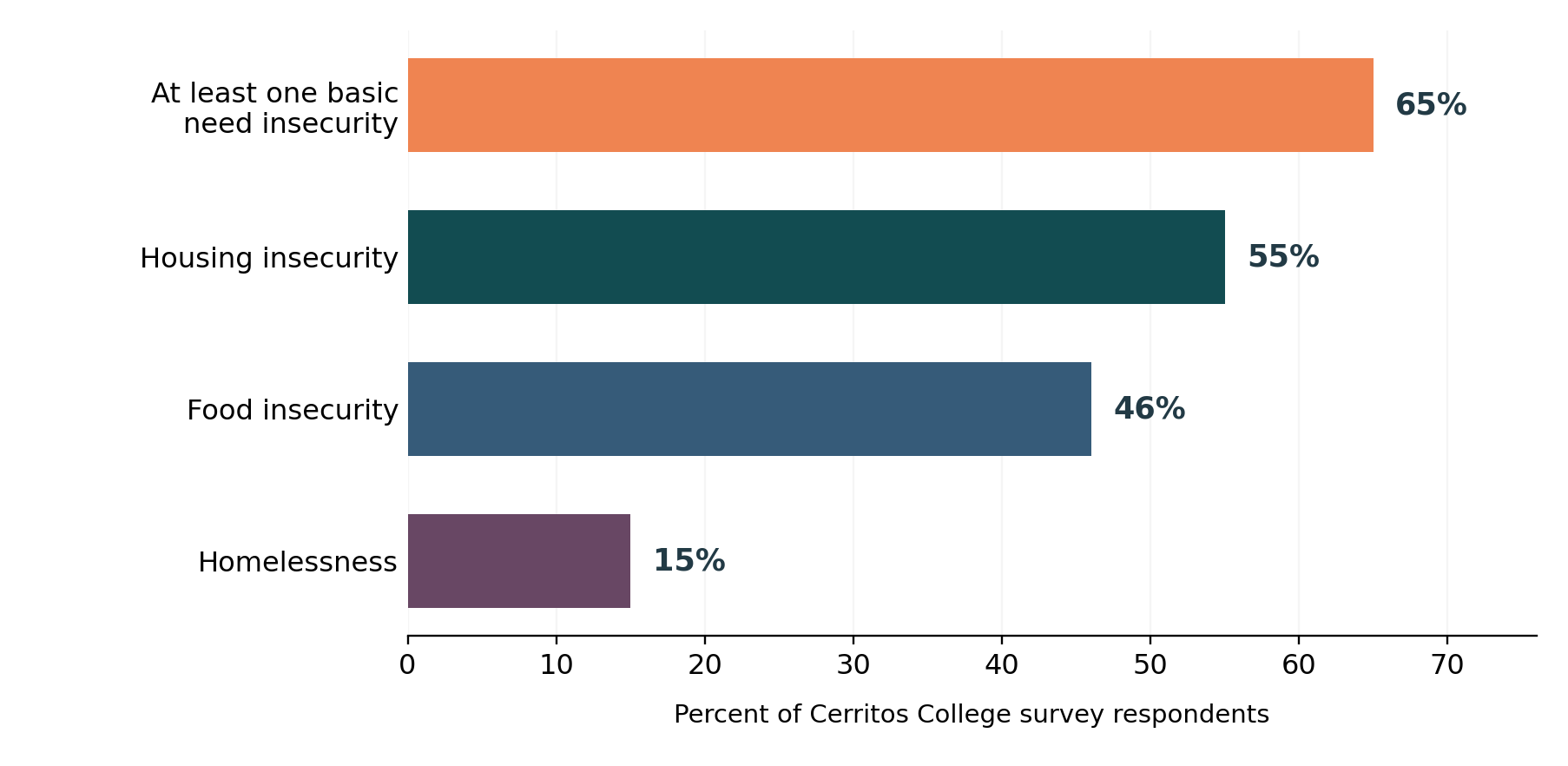
Cerritos College’s survey snapshot before The Village opened. These figures describe survey respondents, not all enrolled students.
The college recognized an institutional problem that could not be solved by tuition assistance alone: students can have a financial aid award and still lack a safe place to sleep. The Village was a response to that specific gap.
The operating model: a property owner and a housing specialist
The Village opened in summer 2020 within walking distance of campus. It consists of seven townhomes and was designed to accommodate up to 28 students ages 18 through 24. Cerritos College secured the property using general funds. The nonprofit Jovenes took a master lease and assumed daily operations. Its responsibilities include resident selection with the college, supervision, property maintenance, housing case management, and support for academic goals.
The original design combined housing without rent for students in immediate crisis with affordable, subsidized room rentals. Jovenes described space for approximately 12 students in bridge housing and up to 14 in room rental arrangements, alongside onsite staffing. Those are elements of the original program design, not a verified current occupancy count.
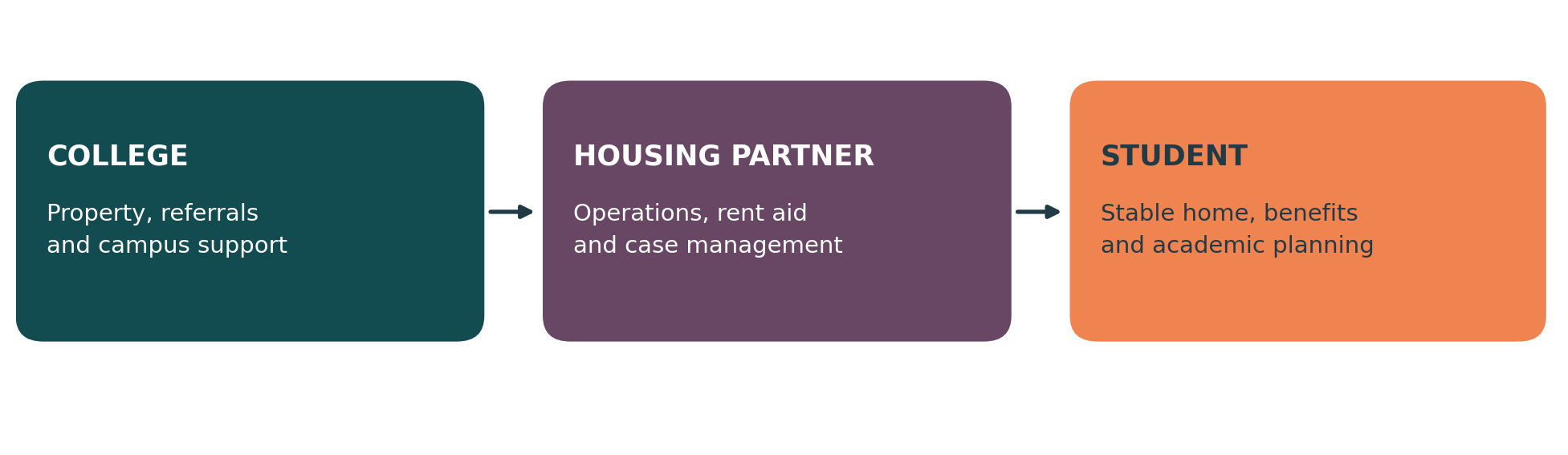
Replicable structure: the college brings property and student connections; a specialized housing partner manages placements and ongoing support.
Students can also be referred to other housing options when the townhomes are full. That overflow pathway matters. A small building can demonstrate what works, but a college serving tens of thousands of students should not rely on a few beds as its entire response.
The results: stronger completion, with an important caveat
In 2023, Cerritos College reported that 40% of students housed at The Village had earned a degree or certificate within their first two years, compared with 15% of its general student population. The 25 percentage point difference is substantial. It suggests that combining a stable home with supportive services can coincide with meaningful educational progress.
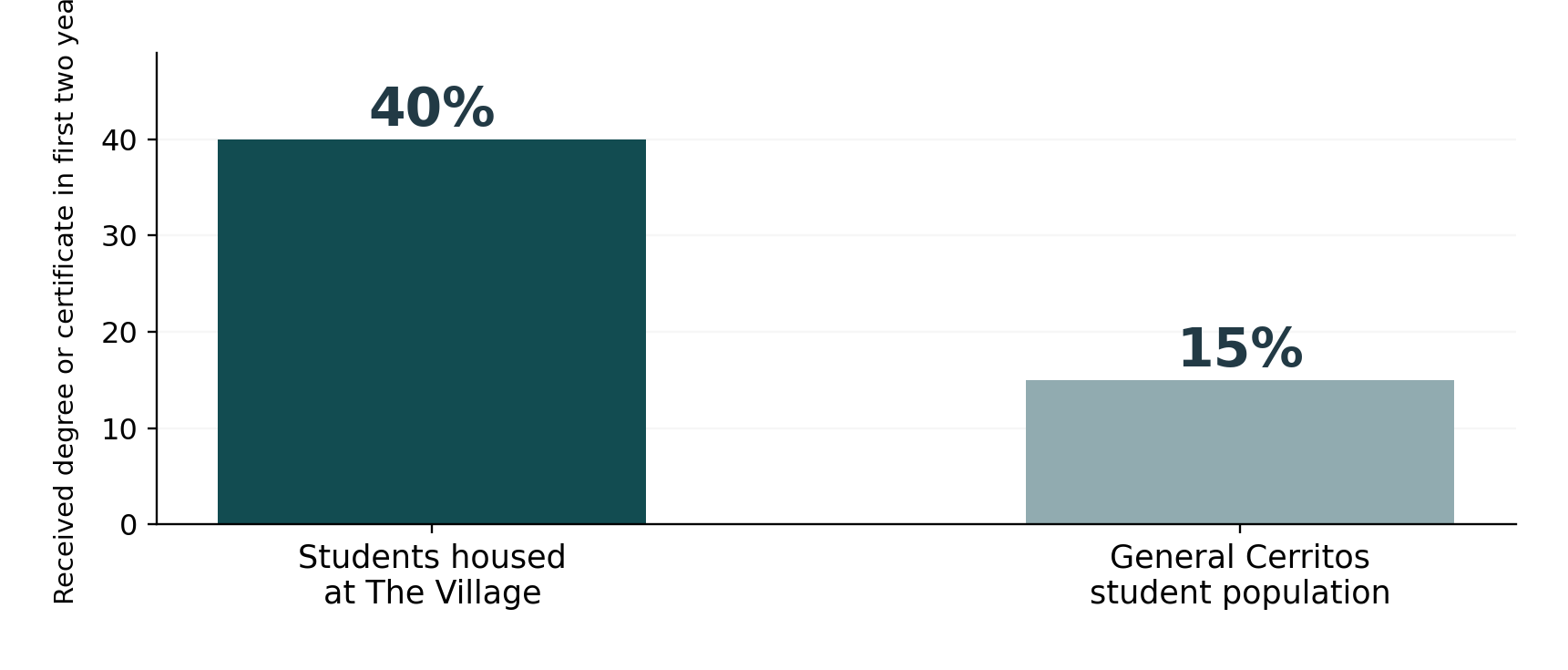
Two year credential attainment reported by the college in 2023. Comparison is descriptive, not a randomized estimate of impact.
This result needs careful interpretation. The two groups were not randomly assigned. Village participants may differ from the full student population in motivation, academic standing, enrollment intensity, access to advising, or other characteristics. The published college summary does not provide the underlying sample sizes or an adjusted impact estimate. The graph is evidence of an encouraging association, not proof that housing alone produced a 25 point gain.
A second signal: participation in academic planning
A 2024 account from the Council for Advancement and Support of Education reported that 93% of students across Cerritos College housing assistance programs participated in a comprehensive education plan, compared with 68% of students outside those programs. This is broader than The Village alone, so it should not be described as a Village specific result. It illustrates the academic support culture surrounding the housing effort.
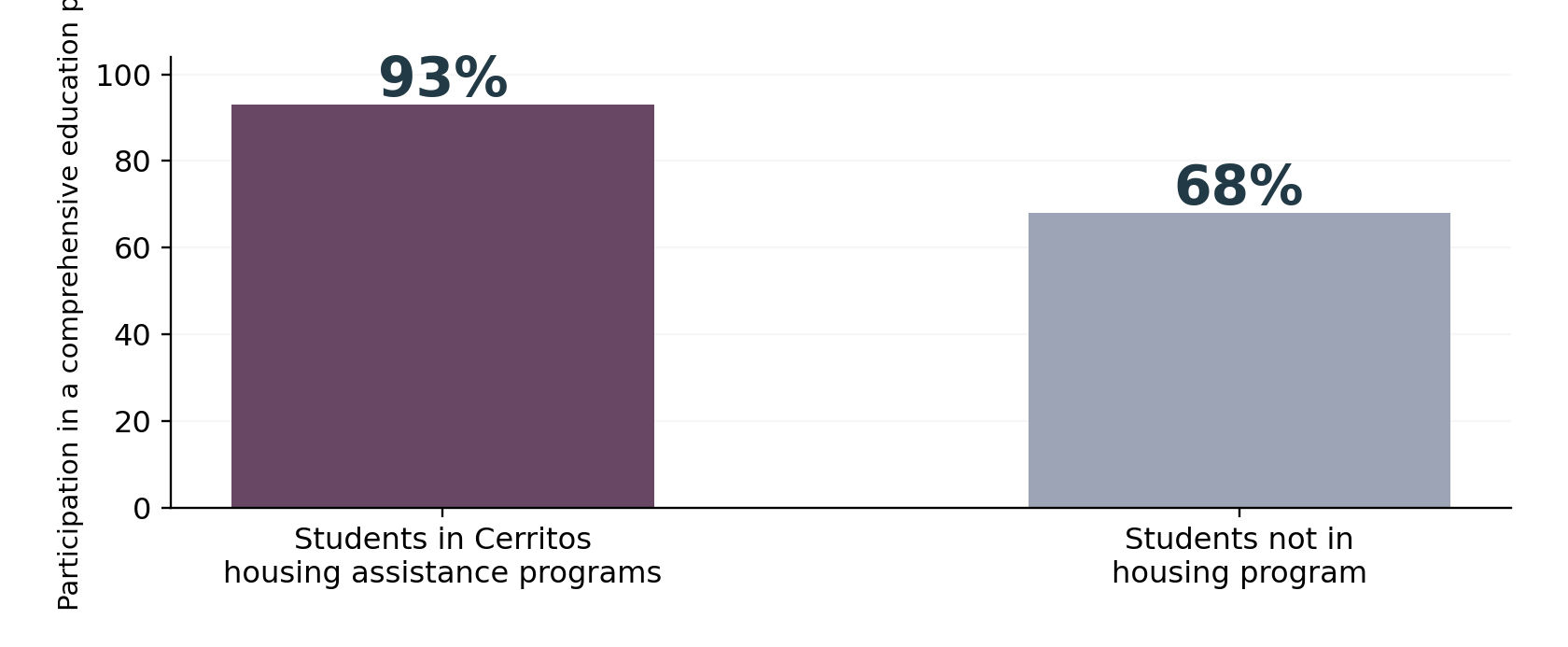
Education plan participation across Cerritos College housing assistance programs; the left group is not limited to Village residents.
Housing case managers and campus staff can coordinate academic advising, financial literacy, food access, and assistance with public benefits. The operating lesson is that a bedroom solves the immediate housing problem while a coordinated support plan helps students make use of the stability it provides.
What students receive besides a key
The Village approach includes practical assistance beyond the room itself: education planning, financial counseling, case management, food access, emergency aid and navigation to other services. Jovenes also uses peer navigators and housing subsidies across a wider college partnership network. The college’s Falcon’s Nest connects students with food, CalFresh applications, emergency assistance, and employment resources.
The human side matters, too. Published student accounts describe the relief of knowing where to sleep, being able to study without repeated moves, and getting help from staff who understand the student’s broader circumstances. Those accounts are illustrative, not substitutes for systematic measurement.
How Cerritos financed the idea and planned to grow
The initial model was intentionally different from building a new residence hall: the college acquired an existing property and leased it to a nonprofit housing operator. Jovenes obtained additional public and private support for ongoing services. That allowed the partners to divide capital expenses from housing operations and case management, although institutions would need local cost estimates before adopting the design.
In September 2024, Cerritos College announced a separate, much larger affordable student housing plan backed by $68 million in state financing and a $12 million college contribution, totaling $80 million and envisioned to provide approximately 400 beds. That announcement described a planned expansion, not 400 completed beds. The Village itself remains the clearer established example of what a smaller college partnership can put into operation.
Six principles other campuses can borrow
• Start with students at risk of losing housing. Use a confidential intake process that identifies unsafe living arrangements, couch surfing, eviction risk, and acute homelessness rather than waiting for a shelter referral.
• Separate property ownership from service delivery. A campus may provide property, beds, or lease commitments while a qualified nonprofit brings housing expertise, landlord relationships, and daily case management.
• Offer more than one housing pathway. Emergency bridge housing, subsidized rooms, help with deposits, and rental assistance can serve different students at different points in a crisis.
• Build academic support into the housing workflow. Assign one accountable point of contact who can coordinate advising, benefits enrollment, work opportunities, and mental health resources.
• Avoid eligibility rules that punish a housing crisis. Cerritos currently lists enrollment and GPA criteria, with consideration for special circumstances. Other institutions should examine whether such requirements exclude the students in greatest danger of leaving school.
• Measure placement and stability, not just applications or bed nights. Track how many students actually move in, maintain safe housing, stay enrolled, finish credentials, and reach independent housing.
A practical 120 day launch plan
Days 1 to 30: understand demand and find partners
Create a small steering group from student affairs, institutional research, facilities, financial aid and local homelessness services. Review current housing requests, available beds and local housing barriers. Ask students with lived experience to assess privacy, accessibility and intake design. Identify a nonprofit or public housing partner with direct experience placing clients.
Days 31 to 60: secure a pilot and define responsibilities
Negotiate a limited pilot around a property, a set of leased rooms or a housing subsidy pool. Put ownership, master leasing, landlord relations, tenant protections, eligibility, safeguarding, staffing and the plan for financial assistance in a written agreement. Set a transparent waiting list process and appeals route.
Days 61 to 90: open intake and make placements
Train advisors and faculty to refer students discreetly. Launch a simple screening form and an emergency safety pathway. Build reliable links to food support, public benefits, transportation, childcare and legal assistance. Begin placements only when case management and after hours crisis procedures are operational.
Days 91 to 120: measure and improve
Review the full journey from request to move in. Record the reasons students cannot secure a unit and test solutions, such as deposit help or additional landlord partnerships. Share an initial report with aggregate housing and student success indicators, and commission a more rigorous evaluation once the program has sufficient scale.
The scorecard every campus should publish
At minimum, the campus should report the number of students requesting help, eligible, offered housing, moved in, and still safely housed at 90 days and 180 days. Educational outcomes should include persistence, credit completion, credentials and transfers. To assess equity, publish results by relevant student groups when group sizes protect privacy, and examine how eligibility requirements influence who gets through the door.
The most useful comparison is with similarly situated students who were eligible but could not be served, with reasonable safeguards against differences in prior academic performance and housing need. Cost reporting should distinguish property and capital investment, direct rent subsidy, case management, emergency expenses and staff time. More completed degrees per dollar is a worthwhile goal, but it must be tested rather than assumed.
The honest lesson: a small housing program is not a systemwide cure
The Village demonstrates what a college and housing partner can build together. Its limited capacity, ongoing need for funding, eligibility rules and the need for reliable routes into independent housing are real constraints. The 2025 California evaluation of college focused rapid rehousing programs also documented delayed placements, tight rental markets and the risk of weak transition planning after subsidies end. These are practical cautions, not reasons to abandon student housing assistance.
What makes Cerritos College worth studying is the specificity of its response. It moved from identifying student homelessness to securing housing, assigning operating responsibility, surrounding residents with support and tracking educational progress. That combination gives other colleges a credible starting point for action, even if their own first step is leased apartments rather than a college owned property.
Sources and research notes
The publications below are presented without footnote numbering. Each contains a direct URL. Historical student surveys, Village specific college outcomes, results from broader Cerritos housing programs and statewide evaluations are identified separately in the article rather than combined as though they measured the same cohort.
Cerritos College, The Village at Cerritos College: Supporting Students Facing Housing Insecurity, 2020 white paper.
https://www.cerritos.edu/campus-life/thevillage/_includes/docs/The_Village_White_Paper_ua.pdf
Original program design, financing, property structure, and campus survey estimates.
Cerritos College, Cerritos College’s Housing Project for Homeless Students Is 2023 Excelencia Award Finalist, August 2023.
https://www.cerritos.edu/newsroom/releases/2023/08/Exelencia.htm
College reported two year degree or certificate attainment comparison: 40% and 15%.
Jovenes, College Housing and College Success Initiative.
https://jovenesinc.org/college-housing/
Nonprofit partner’s program design, housing operations, bridge housing, rental support and regional network.
Cerritos College, The Village program homepage.
https://www.cerritos.edu/campus-life/thevillage/default.htm
Official program framing, campus need, and access information.
Cerritos College, Falcon’s Nest: Jovenes partnership and housing referral requirements.
https://www.cerritos.edu/support/falcons-nest/jovenes-inc.htm
Current publicly listed requirements and exceptional circumstance policy.
Ellen N. Woods, A Place to Call Home, Council for Advancement and Support of Education, March 2024.
https://www.case.org/resources/place-call-home
Independent interviews, Jacqueline Benitez’s story, funding context and the broader 93% versus 68% education planning comparison.
Cerritos College, New Affordable On Campus Student Housing a Reality at Cerritos College, September 2024.
https://www.cerritos.edu/newsroom/releases/2024/09/SB-155.htm
Reported financing plan and proposed additional affordable student beds; not a verification of construction completion.
Simten Cekicer, Unhoused Students and the Role of Community College Leadership: A Case Study of The Village at Cerritos College, California State University Fullerton dissertation, June 2026.
https://zenodo.org/records/20533770
Qualitative interviews and analysis of leadership, sustainability, and nonprofit partnership model.
Center for Equitable Higher Education, College Focused Rapid Rehousing Evaluation Final Report, May 2025.
Multicampus evidence about placement speed, housing stability, program implementation and limitations; not Village specific findings.
California Legislative Analyst’s Office, Update on Student Housing Assistance, May 2024.
https://lao.ca.gov/Publications/Report/4898
California state funding and evidence context for college housing support programs.